हिंदी में पढ़े : आधुनिक रिश्तें क्यों टूट रहे हैं ? लम्बे समय तक टिकने वाले प्रेम के पांच स्तम्भ
Every evening, I take my little son to a nearby park.
It is one of those places where life quietly unfolds many of thebefore your eyes. Children run around with endless joy, grandparents walk hand in hand with their grandchildren, young couples sit together on benches, and families gather to spend a peaceful evening.
At first glance, everything looks beautiful.
But whenever I sit quietly for a while and simply observe people, a different picture begins to emerge.
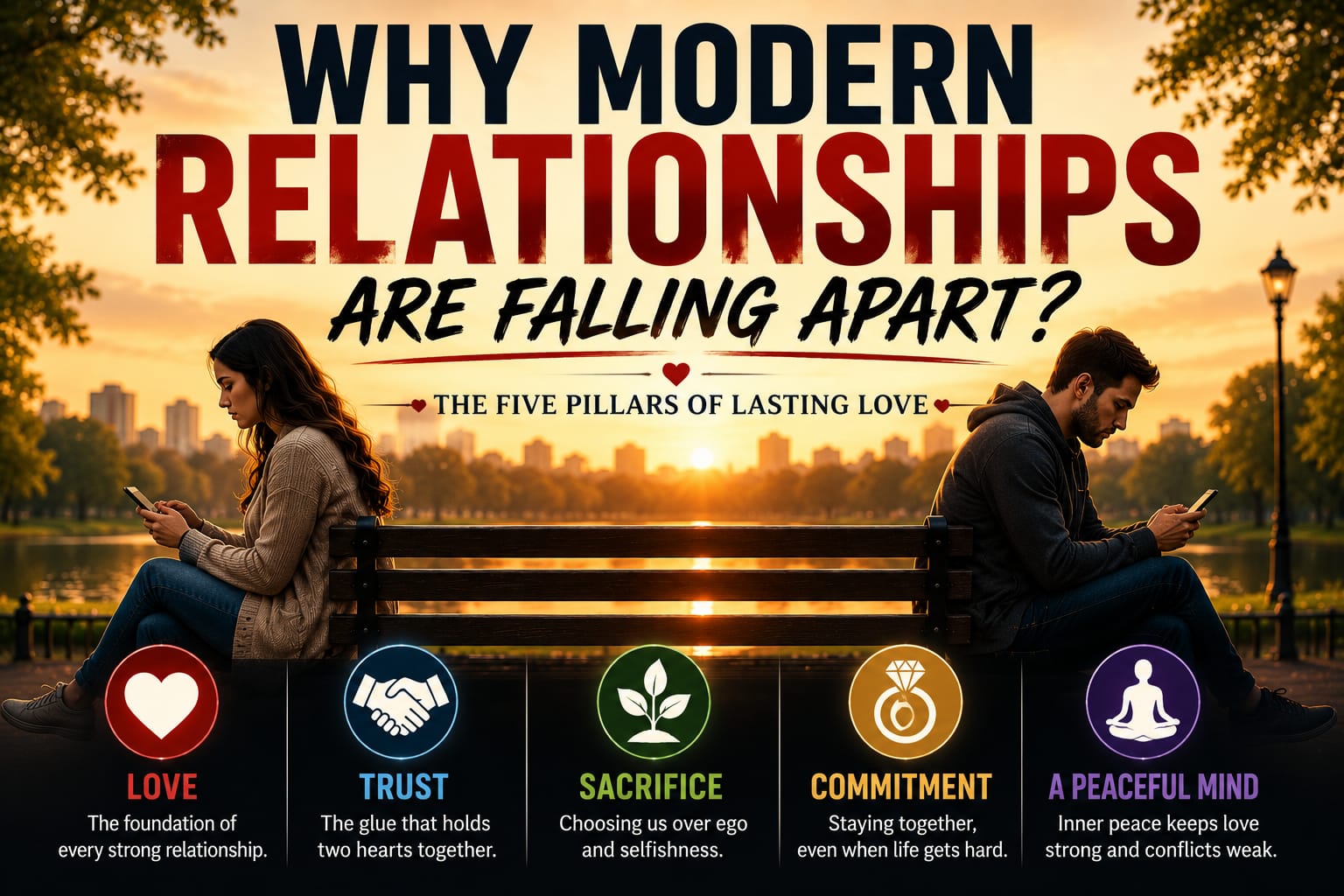
I notice that many people are physically together, yet emotionally far apart.
Almost every hand holds a smartphone or a tablet.
They come to the park to spend quality time together, yet much of that time is spent staring at a screen instead of looking into each other’s eyes.
Sometimes a small disagreement suddenly turns into an argument.
Voices become louder.
Frustration appears on their faces.
It feels as though they are sitting side by side, yet somewhere deep inside they have already drifted apart.
That evening, a question quietly entered my mind.
**Is this happening only to a few people, or are all of us slowly experiencing the same reality?**
**Are modern relationships truly becoming weaker?**
**Or have invisible forces entered our lives that are quietly stealing the emotional closeness between two people?**
These questions stayed with me long after I left the park.
As I reflected on them, I realized that every strong and lasting relationship seems to stand upon **five timeless pillars**.
Just as a mighty tree survives the strongest storms because its roots remain deeply connected to the soil, every meaningful relationship also draws its strength from five essential foundations:
 Love
Love
 Trust
Trust
 Sacrifice
 Commitment
 A Peaceful Mind
The moment even one of these pillars begins to weaken, the relationship slowly starts losing its strength.
**Perhaps this is the greatest crisis facing modern relationships today.**
Why Modern Relationships Feel Different Today
Love has not disappeared.
People still fall in love.
People still dream of finding someone with whom they can share their lives.
Yet relationships today seem more fragile than ever before.
Many couples who once believed they were “perfect for each other” find themselves emotionally exhausted within a few years—or sometimes even a few months.
Why?
The answer goes far beyond technology or social media.
The real change has taken place inside the human mind.
For the first time in history, we are exposed to thousands of lifestyles, opinions, relationships, and expectations every single day.
Social media constantly whispers:
*”Someone else is happier.”*
*”Someone else has found a better partner.”*
*”Someone else is living a more exciting life.”*
Without realizing it, we begin comparing our ordinary lives with carefully edited highlights from other people’s lives.
Comparison slowly destroys gratitude.
When gratitude disappears, emotional intimacy begins to fade.
And when emotional intimacy fades, even love struggles to survive.
Have We Confused Love with Attraction?
One of the greatest misunderstandings of modern relationships is that we often mistake **attraction** for **love**.
Attraction is exciting.
It is often based on beauty, personality, success, or mystery.
But attraction naturally changes with time.
Love is different.
Love begins where attraction slowly ends.
Attraction asks,
*”What can this person give me?”*
Love quietly asks,
*”How can I help this person grow?”*
Attraction seeks excitement.
Love builds security.
Attraction looks for perfection.
Love embraces imperfection.
History is filled with stories of people who sacrificed comfort, wealth, and even their own lives for those they truly loved.
Even today, genuine love still exists.
The problem is not that love has disappeared.
The problem is that modern culture often celebrates attraction more than commitment.
—
Why Earlier Relationships Lasted Longer
It would be wrong to say that relationships in the past were perfect.
They also experienced misunderstandings, disagreements, financial struggles, and personal sacrifices.
Yet many couples remained together for decades.
Why?
Perhaps because relationships were built slowly.
People spent more time talking than texting.
Families shared meals without constant digital distractions.
Problems were solved through conversations instead of silent resentment.
Instead of constantly searching for someone better, many people focused on becoming a better partner themselves.
Life was simpler.
Expectations were lower.
Patience was greater.
This does not mean the past was perfect.
But it reminds us of something important:
**Strong relationships are not built through constant excitement.**
**They are built through consistent effort, mutual respect, and emotional presence.**
Too Many Choices, Less Satisfaction
One of the greatest psychological challenges of modern relationships is what researchers often call **the paradox of choice**.
Never before in human history have we had so many opportunities to meet new people. Dating apps, social media platforms, and instant messaging have made it possible to connect with thousands of individuals within minutes.
At first, this seems like freedom.
But surprisingly, unlimited choices often create less satisfaction rather than more happiness.
Our minds begin to whisper:
*”What if someone better is out there?”*
*”What if I settle too soon?”*
*”What if this isn’t the right relationship?”*
Instead of appreciating the person standing beside us, we become distracted by endless possibilities.
Ironically, when everything seems replaceable, commitment becomes difficult.
A lasting relationship is rarely built by constantly searching for someone better.
It is built by becoming a better partner every single day.
—
The Trap of Instant Gratification
Modern life has trained us to expect immediate results.
Food arrives within minutes.
Movies begin instantly.
Messages are delivered in seconds.
A single tap brings endless entertainment.
Without realizing it, we carry the same expectations into our relationships.
We expect immediate understanding.
Immediate happiness.
Immediate forgiveness.
Immediate perfection.
But love has never worked that way.
A meaningful relationship is much like planting a tree.
It needs time.
Patience.
Care.
Consistency.
No one digs up a tree every week to check whether its roots are growing.
Yet many people constantly test their relationships instead of nurturing them.
The strongest couples are rarely the luckiest.
They are simply the ones who choose patience over impatience, understanding over assumptions, and commitment over convenience.
The Five Pillars of Lasting Love
After reflecting on countless relationships around me, I realized that every strong relationship seems to stand upon five timeless pillars.
Whenever one of these pillars begins to weaken, the relationship gradually loses its balance.
1. Love
Love is more than an emotion.
It is a daily choice.
Real love is revealed not during easy moments, but during life’s greatest challenges.
Attraction asks,
*”What can this person give me?”*
Love asks,
*”How can we grow together?”*
2. Trust
Trust is the invisible bridge connecting two hearts.
Without trust, even silence becomes suspicious.
A delayed reply.
A missed call.
A simple misunderstanding.
Everything begins to feel like betrayal.
Where trust exists, conversations replace assumptions.
3. Sacrifice
Every meaningful relationship requires sacrifice.
Not because love is painful…
But because love teaches us that **”We” is often more important than “Me.”**
Sometimes we sacrifice comfort.
Sometimes time.
Sometimes ego.
True sacrifice is not losing ourselves.
It is choosing the relationship over unnecessary pride.
4. Commitment
Attraction may bring two people together.
Commitment keeps them together.
Anyone can stay when life is easy.
Commitment is revealed when life becomes difficult.
It quietly says,
*”Even during the hardest seasons, I will continue choosing us.”*
5. A Peaceful Mind
Perhaps this is the most overlooked pillar of all.
An anxious mind creates unnecessary conflict.
An angry mind creates painful words.
An insecure mind creates constant suspicion.
A peaceful mind creates understanding.
Today, the greatest test of inner peace often appears on a smartphone screen.
A partner’s “Last Seen.”
A delayed reply.
A social media notification.
An untrained mind immediately creates stories that may not even be true.
A peaceful mind chooses conversation before conclusion.
Many relationships do not end because of reality.
They end because of assumptions created inside an anxious mind.
What Modern Psychology Says About Healthy Relationships
Modern psychology consistently points toward one simple truth:
Healthy relationships are not built by perfect people.
They are built by emotionally mature people.
Research and relationship experts repeatedly highlight habits that strengthen long-term relationships:
• Active listening instead of constant arguing.
• Emotional safety instead of fear.
• Gratitude instead of entitlement.
• Respect instead of control.
• Honest communication instead of assumptions.
• Forgiveness instead of keeping score.
Interestingly, these principles are not new.
Modern psychology is simply confirming what timeless wisdom has taught for centuries:
**Strong relationships begin with a healthy mind before they become a healthy partnership.**
Timeless Wisdom: What Osho, Buddha, and the Bhagavad Gita Teach Us About Lasting Love
Throughout history, great spiritual teachers have explored the nature of love, attachment, ego, and the human mind. Although they lived in different times and taught in different ways, Osho, the Buddha, and the Bhagavad Gita all point toward a similar truth:
**A healthy relationship begins with a healthy mind.**
Osho: Love Needs Freedom, Not Possession
Osho’s teachings often distinguish **love** from **attachment**. According to his philosophy, love cannot truly flourish where there is fear, control, or the desire to possess another person. When love turns into ownership, it slowly loses its beauty and becomes emotional dependence.
Many modern relationships struggle not because people stop loving each other, but because they begin trying to control one another.
Questions like:
• “Who were you talking to?”
• “Why were you online so late?”
• “Why didn’t you reply immediately?”
…gradually replace trust with suspicion.
Over time, love begins to feel less like a joyful connection and more like a constant obligation.
One of Osho’s recurring ideas is that **love needs freedom and space to grow**. He often compared healthy relationships to two trees growing side by side—close enough to share the same sky, yet with enough space for each to grow into its full potential.
Healthy relationships work in much the same way.
Each partner should have the freedom to pursue personal dreams, maintain friendships, enjoy individual interests, and spend time alone without fear or guilt.
Giving each other space does not weaken love.
It strengthens trust, individuality, and mutual respect.
Ironically, the tighter we try to hold on to someone, the more likely they are to feel trapped.
But when love is built on trust and freedom, people often choose to stay—not because they are forced to, but because they genuinely want to.
Perhaps one of the greatest lessons from Osho’s philosophy is this:
> **Love flourishes not through possession, but through freedom, trust, and conscious awareness.**
Buddha: Expectations Create Suffering
More than 2,500 years ago, the Buddha taught that much of human suffering arises from **craving, attachment, and unrealistic expectations**.
This teaching lies at the heart of the **Second Noble Truth (Samudaya)**, which explains that suffering (*Dukkha*) is rooted in *Taṇhā*—our tendency to cling, demand, and expect life to unfold exactly as we wish.
This wisdom remains remarkably relevant in modern relationships.
Many relationships begin with silent expectations:
• “My partner should always understand me.”
• “My partner should never disappoint me.”
• “My partner should make me happy all the time.”
But no human being is perfect.
When expectations become greater than acceptance, disappointment becomes inevitable.
Small misunderstandings gradually become emotional distance.
Unspoken expectations slowly weaken trust.
The Buddha did not teach us to stop loving people.
Instead, he encouraged us to love with awareness, compassion, patience, and acceptance rather than clinging with fear or unrealistic demands.
A relationship becomes stronger when acceptance grows greater than expectation and compassion replaces the desire to control another person.
Perhaps one of the greatest lessons from the Buddha is this:
> **The more we try to possess people, the more we suffer. The more we learn to understand and accept them, the more peacefully love can grow.**
Bhagavad Gita: Master Yourself Before Trying to Change Others
The **Bhagavad Gita** is often regarded as a spiritual scripture, but it is equally a profound guide to understanding the human mind and mastering one’s emotions.
Rather than teaching us how to control others, it encourages us to first understand and govern ourselves.
Lord Krishna reminds Arjuna that the greatest victory is not over another person, but over one’s own restless mind.
A disciplined mind becomes our greatest friend.
An uncontrolled mind becomes our greatest enemy.
This timeless wisdom is especially relevant to modern relationships.
Many relationships begin to weaken when anger controls our words…
When ego influences our decisions…
When emotional attachment clouds our judgment…
We often ask,
*”Why doesn’t my partner understand me?”*
Yet the Bhagavad Gita gently invites us to ask a far more important question:
**”Have I learned to understand and master myself?”**
A healthy relationship does not begin with changing another person.
It begins with cultivating qualities within ourselves such as:
• Self-control
• Truthfulness
• Compassion
• Forgiveness
• Steadiness of mind
These virtues not only shape our character but also strengthen every relationship we build.
When the mind is calm, communication becomes kinder.
Conflicts become easier to resolve.
Trust grows naturally.
Perhaps this is why **A Peaceful Mind** is one of the Five Timeless Pillars of Lasting Love.
Before we seek the perfect partner, we must first learn to become a better version of ourselves.
> **A relationship becomes stronger when two people focus less on changing each other and more on mastering their own minds.**
Philosophical References
**Osho:** Inspired by the core themes presented in *Love, Freedom, Aloneness: The Paradox of Marriage and Relationships*, where Osho explores love, individuality, emotional freedom, and conscious relationships.
**The Buddha:** Based on the Second Noble Truth (*Samudaya*) in the Pali Canon, which identifies *Taṇhā* (craving and attachment) as the primary cause of suffering (*Dukkha*).
**Bhagavad Gita:** Inspired by Chapter 6, Verse 6 (the disciplined mind as one’s greatest friend) and Chapter 6, Verse 35 (mastering the restless mind through practice and detachment).
The Silent Crisis of the Digital Age
Technology has connected billions of people across the world.
Yet, many hearts have never felt more disconnected.
Never before have we had so many ways to communicate, yet genuine conversations have become increasingly rare.
Today we compare our relationships, careers, lifestyles, and even our happiness through carefully curated moments shared on social media.
The problem is not social media itself.
The problem begins when comparison replaces gratitude and virtual interactions replace meaningful conversations.
Social media rarely shows ordinary moments.
It presents carefully edited highlights—the happiest smiles, the most romantic vacations, and seemingly perfect relationships.
Without realizing it, we begin comparing our everyday reality with someone else’s best moments.
Comparison creates dissatisfaction.
Dissatisfaction weakens gratitude.
When gratitude disappears, emotional intimacy slowly fades.
Perhaps the saddest reality of modern life is this:
**Families often sit together in the same room, yet live in completely different digital worlds.**
Everyone is connected to the internet.
Very few are deeply connected to each other.
Technology is not the enemy.
The real danger begins when screens receive more attention than the people sitting beside us.
How Can We Build Relationships That Last?
Strong relationships are rarely built by luck.
They are built through small choices repeated every single day.
Here are a few timeless habits that can strengthen any relationship:
• Listen more than you speak.
• Choose conversation over assumptions.
• Express appreciation regularly.
• Respect each other’s individuality.
• Spend distraction-free quality time together.
• Learn to apologize sincerely.
• Forgive without keeping score.
• Protect your inner peace.
• Grow together instead of competing against each other.
Above all, remember this:
**Love is not a one-time emotion. It is a daily practice.**
Final Thoughts
Modern relationships are not failing because love has disappeared.
They often struggle because attraction replaces love, comparison replaces gratitude, distraction replaces presence, ego replaces commitment, and an anxious mind replaces a peaceful one.
In my understanding, every lasting relationship stands upon **Five Timeless Pillars**:
Love
Trust
Sacrifice
Commitment
A Peaceful Mind
Just as a tree cannot survive without deep roots, relationships cannot survive without strong foundations.
Perhaps the greatest relationship we will ever build is not by finding the perfect partner…
But by becoming a person capable of loving deeply, trusting sincerely, sacrificing wisely, remaining committed, and cultivating inner peace.
As we strive to improve our relationships with others, we should also remember to improve the relationship we have with ourselves.
Because a peaceful heart creates peaceful relationships.
And peaceful relationships create a meaningful life.
> **”Strong relationships are not built by perfect people. They are built by imperfect people who choose love over ego, trust over fear, sacrifice over selfishness, commitment over convenience, and peace over unnecessary conflict.”**
Frequently Asked Questions (FAQs)
1. Why do modern relationships fail so quickly?
Many relationships struggle because of poor communication, unrealistic expectations, emotional immaturity, constant comparison, and digital distractions.
—
2. Is social media ruining relationships?
Social media itself is not the problem.
The problem begins when comparison, insecurity, and excessive screen time replace genuine communication and emotional presence.
—
3. What are the Five Pillars of Lasting Love?
The five essential pillars are:
• Love
• Trust
• Sacrifice
• Commitment
• A Peaceful Mind
Together, these pillars create the emotional foundation needed for a healthy and lasting relationship.
—
4. What does modern psychology say about healthy relationships?
Modern psychology suggests that healthy relationships are built on emotional safety, honest communication, empathy, gratitude, forgiveness, and mutual respect.
—
5. Can ancient wisdom still help modern relationships?
Yes.
The teachings of Osho, the Buddha, and the Bhagavad Gita continue to offer timeless insights into human psychology, emotional balance, compassion, mindfulness, and self-awareness—all of which remain deeply relevant in today’s relationships.
Disclaimer
This article is intended for educational and reflective purposes only. The ideas presented are inspired by the philosophical teachings of Osho, the Buddha, and the Bhagavad Gita, along with the author’s personal observations and reflections. The interpretations shared here are intended to encourage thoughtful discussion and self-reflection and should not be considered definitive or exhaustive explanations of the original teachings. Readers are encouraged to explore the original texts for a deeper understanding.
A Message for Our Readers
Your Turn
Now I’d love to hear from you.
**Which of these Five Pillars do you think has become the weakest in modern relationships today?**
Love
Trust
Sacrifice
Commitment
A Peaceful Mind
Or do you believe something else is quietly weakening modern relationships?
**Share your thoughts in the comments below.**
Your perspective might help someone see relationships—and perhaps even themselves—in a completely new way.
Thank you for reading.
If this article made you pause, reflect, or see relationships from a new perspective, consider sharing it with someone you care about.
Sometimes, a meaningful conversation begins with a single thoughtful article.
Thank you for being a part of the Gossip of Mind community.
Leave a Reply