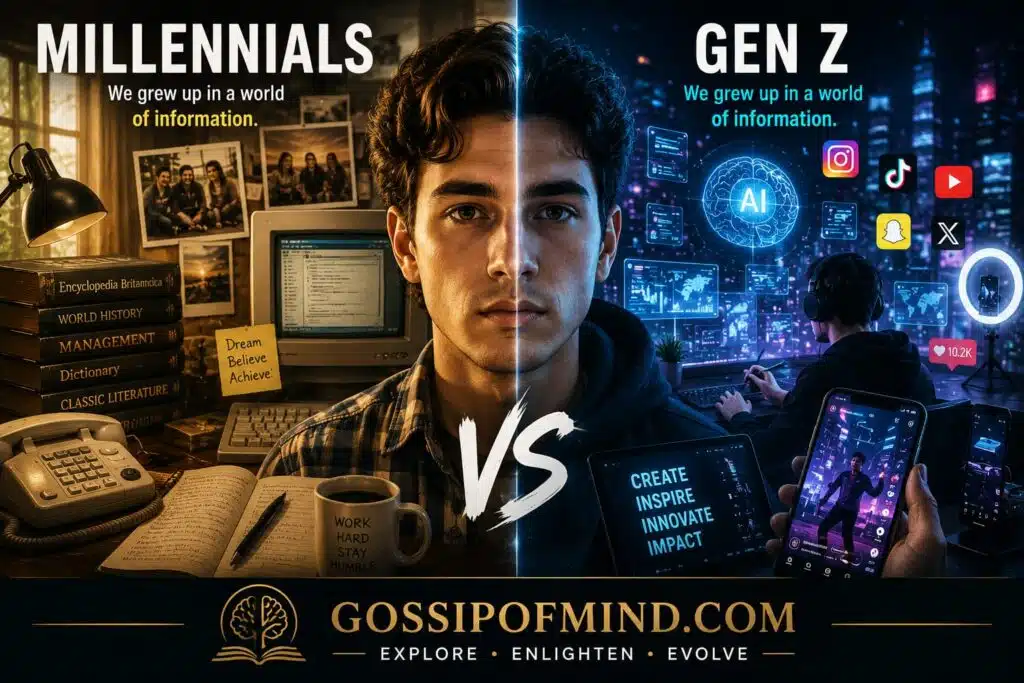
What if the biggest misunderstanding about generations isn’t who is better—but how we judge them?
Imagine placing two children in the same room.
One was born in 1988.
The other was born in 2008.
Now ask them the same question.
The first child walks toward a bookshelf.
The second child reaches for a smartphone.
Within seconds, the younger child finds the answer.
Most people watching this scene would immediately conclude,
“The younger generation is smarter.”
But pause for a moment.
Is the younger child truly more intelligent?
Or did they simply inherit better tools?
That single misunderstanding lies at the heart of almost every debate about generations.
For decades, humanity has compared one generation with another.
Parents compare themselves with their children.
Children compare themselves with their parents.
Social media amplifies these comparisons every single day.
“Gen Z is lazy.”
“Millennials are outdated.”
“Older generations don’t understand technology.”
“Young people have no patience.”
Every generation believes it has discovered the truth.
Ironically, every generation has made the same claim.
History keeps repeating the conversation.
Only the names of the generations change.
Perhaps the real problem has never been the generations themselves.
Perhaps the problem is the question we ask.
Instead of asking,
“Which generation is better?”
we should ask,
“What kind of world shaped this generation?”
That single question changes everything.
We Often Mistake Progress for Superiority
Imagine asking a surgeon from today to compete with a surgeon from two hundred years ago.
The modern surgeon would almost certainly perform better.
But would that prove the modern surgeon was born more intelligent?
Of course not.
Today’s surgeon benefits from centuries of scientific discoveries, improved education, advanced instruments, safer medicines, and the experience of countless doctors who came before.
Human progress has always worked like a relay race.
No runner begins from the starting line.
Each runner begins where the previous runner finished.
Generations work exactly the same way.
Millennials inherited a world built by earlier generations.
Generation Z inherited a world transformed by the internet, smartphones, and digital technology.
Tomorrow, Generation Alpha will inherit a world shaped by Artificial Intelligence.
Every generation starts from a different point because every generation receives a different inheritance.
Some inherit books.
Some inherit computers.
Some inherit artificial intelligence.
The inheritance changes.
Human nature does not.
This is why comparing generations without understanding their environments often leads to unfair conclusions.
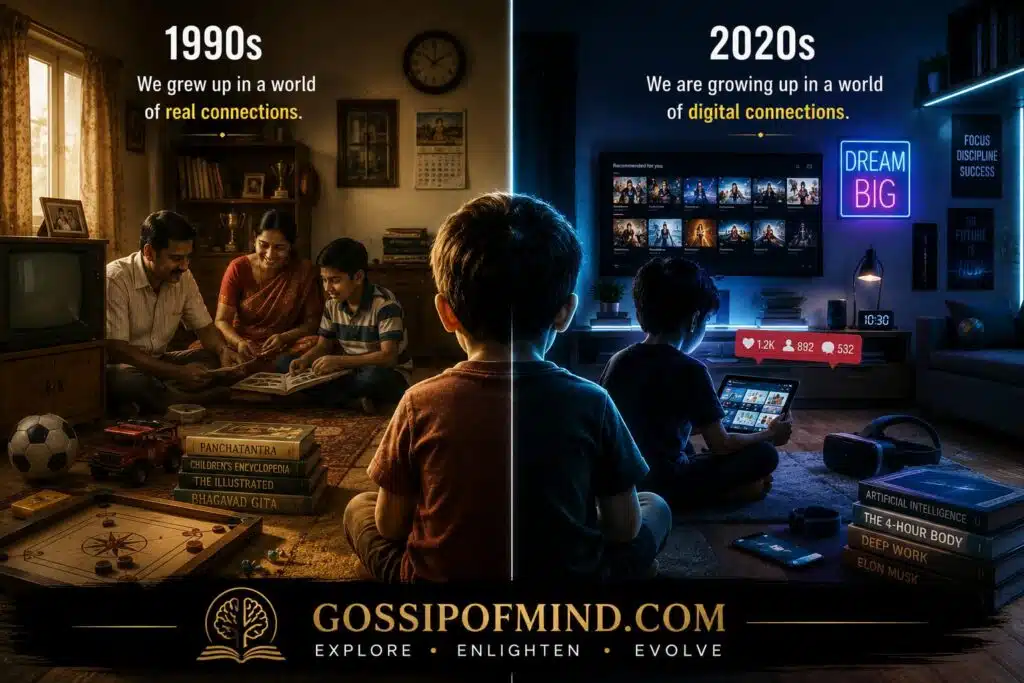
The Environment Writes the First Draft of Every Human Mind
A newborn baby enters the world without opinions, beliefs, ambitions, or prejudices.
The child does not know success.
The child does not know failure.
The child does not know religion, politics, money, or social status.
The only extraordinary ability the child possesses is the ability to learn.
Everything else arrives later.
Family.
School.
Friends.
Culture.
Society.
Failures.
Successes.
Technology.
Books.
Life itself slowly writes the first draft of that child’s mind.
By adulthood, we call that draft a personality.
Psychologists explain this through learning, observation, and environmental influence.
Philosophers often describe it as conditioning.
Parents simply call it upbringing.
Different words.
The same truth.
People do not grow in isolation.
They grow inside environments.
A child raised in a village develops different strengths from a child raised in a busy metropolitan city.
A child raised before the internet develops different habits from one who grows up with artificial intelligence.
Neither child is superior.
Each becomes an expert at solving the problems of their own world.
That is why every generation thinks differently.
Not because one generation was born wiser.
But because every generation inherited a different classroom called life.
Perhaps this is the first truth we forget whenever we compare generations.
We compare people.
When we should be comparing the worlds that shaped them.
And once we understand the power of environment, another important question naturally follows:
If environment shapes our thinking, how does it influence our habits, discipline, and personality?
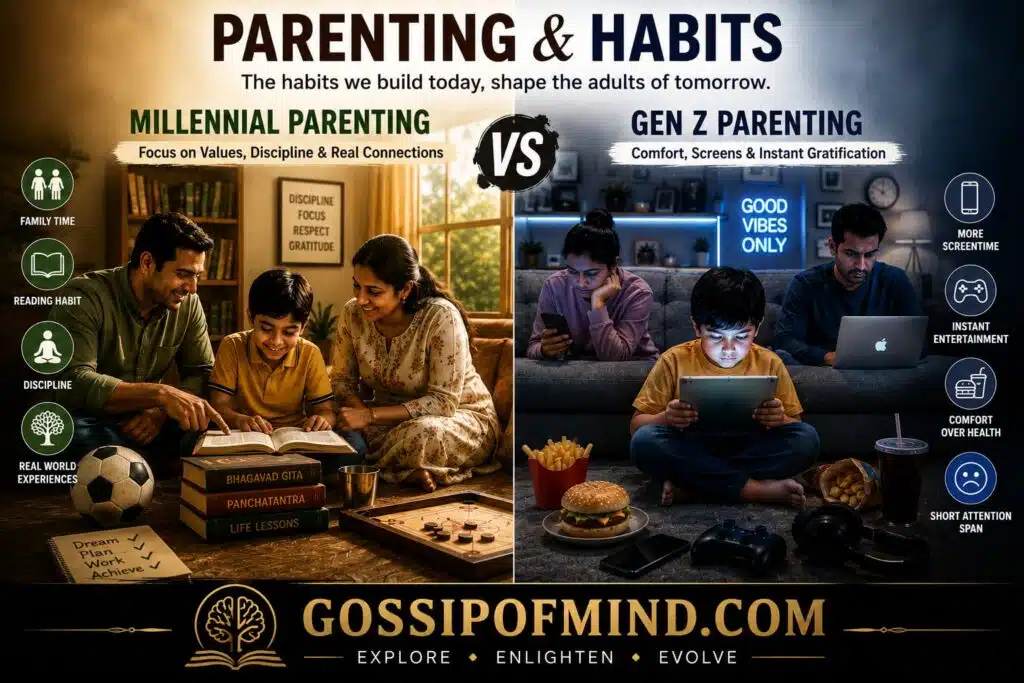
Habits: We Become What Our Environment Repeats
Have you ever wondered why one generation is often described as patient while another is called restless?
Is it because human nature suddenly changed?
Probably not.
A better explanation is that habits are shaped by repetition, and repetition is shaped by environment.
Think about a child growing up in the early 1990s.
If that child wanted to watch a favorite television program, there was only one option—wait for the scheduled broadcast. Miss it, and there was no replay.
If they wanted information, they visited a library or searched through textbooks.
If they wanted to speak to a relative living far away, they waited for the right time to make a phone call or wrote a letter.
Waiting was not a lesson.
It was simply life.
Without realizing it, that environment trained patience, delayed gratification, and persistence.
Now imagine a child growing up today.
Movies stream instantly.
Food arrives at the tap of a screen.
A question receives an AI-generated answer within seconds.
Friends are available through video calls at any moment.
The environment teaches a different lesson:
Speed is normal.
Neither lesson is wrong.
Both are responses to different worlds.
When the environment changes, habits change with it.
That is why judging one generation using the standards of another often creates misunderstanding instead of wisdom.
Discipline Is Not a Generational Trait
Many people claim that Millennials are naturally more disciplined than Generation Z.
Others argue exactly the opposite.
Perhaps both sides are asking the wrong question.
Discipline is not inherited through birth years.
It is developed through daily routines, expectations, responsibilities, and role models.
A child who grows up watching parents work honestly, keep promises, and respect time is more likely to develop similar habits.
A child who grows up in an environment without consistency may struggle to build those habits, regardless of the year they were born.
This explains why two people from the same generation can have completely different personalities.
One becomes responsible.
Another becomes careless.
One develops emotional resilience.
Another avoids every challenge.
The difference is rarely the generation.
The difference is usually the environment that shaped them.
Parenting: The First School of Human Character
Long before schools begin teaching mathematics or science, parents begin teaching life.
Not only through words.
But through actions.
Children observe far more than adults realize.
They notice how parents react to failure.
How they treat strangers.
How they handle money.
How they resolve disagreements.
How they speak when nobody is watching.
These silent lessons often become lifelong habits.
Over the past few decades, parenting has changed across much of the world.
Families have become smaller.
Living standards have improved.
Children often receive greater emotional support, better education, improved healthcare, and more opportunities than previous generations.
These are remarkable achievements.
However, every improvement brings new responsibilities.
Many child development experts suggest that resilience grows when children are allowed to face age-appropriate challenges instead of being protected from every discomfort.
A butterfly cannot strengthen its wings if someone breaks open the cocoon too early.
Human beings are remarkably similar.
Love helps children grow.
But so do responsibility, accountability, and the freedom to learn from failure.
Healthy parenting is therefore not about strict control.
Nor is it about unlimited freedom.
It is about preparing children for reality while reminding them that they are never alone.
Communication: Faster Than Ever, Deeper Than Ever?
Few things reveal the evolution of society more clearly than communication.
Millennials belong to the last generation that remembers life before constant digital connectivity.
They experienced handwritten letters, postcards, newspapers, landline telephones, face-to-face conversations, emails, text messages, and eventually social media.
They learned to communicate in both an analog and a digital world.
Generation Z entered a completely different reality.
Instant messaging, video calls, voice notes, memes, emojis, livestreams, and short-form videos became part of everyday life.
Never before in history has communication been so fast.
Yet an important question remains.
Has faster communication also made us better communicators?
Technology has made it easier to send messages.
But meaningful communication requires something technology cannot automate.
Listening.
Understanding.
Empathy.
Patience.
Attention.
In an age where conversations compete with notifications and silence competes with endless scrolling, these qualities have become increasingly valuable.
Perhaps the communication skill of the future will not be typing faster.
It will be understanding people more deeply.
Because no technology can replace genuine human connection.
And no generation can thrive without it.
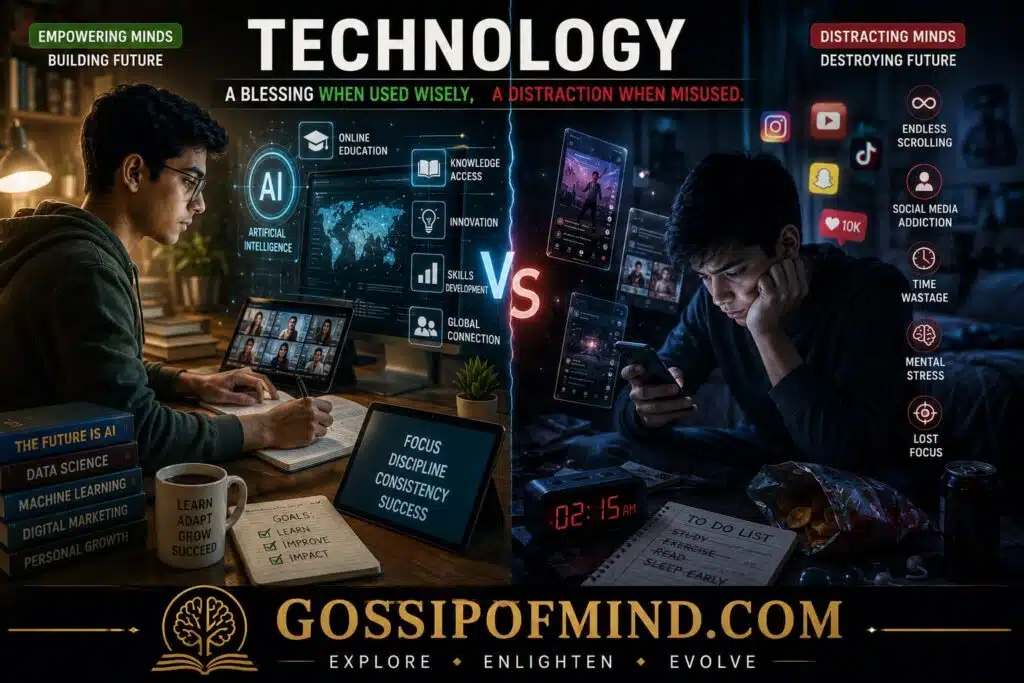
Technology: The Tool That Changed Every Generation
If there is one force that has transformed human civilization more rapidly than almost anything else, it is technology.
It has changed how we learn, work, communicate, travel, build relationships, and even how we think.
Yet when people compare Millennials and Generation Z, they often forget one simple fact:
Technology did not change people overnight. It changed the environment in which people grew up.
That difference is important.
Millennials were not born into a digital world.
They watched it being built.
They experienced cassette tapes becoming MP3 players, desktop computers becoming laptops, internet cafés becoming home Wi-Fi, and basic mobile phones becoming smartphones.
For them, technology was a journey.
Generation Z began that journey much later.
By the time they became aware of the world, the internet was already everywhere.
Touchscreens felt natural.
Google became a habit.
Social media became part of daily life.
Artificial Intelligence is now becoming just another tool they learn alongside calculators and search engines.
Neither experience is superior.
One generation learned to adapt.
The other learned to navigate.
Both required intelligence.
Both required curiosity.
Both required learning.
Every Tool Changes Human Behaviour
History repeatedly shows that every revolutionary tool changes the way human beings behave.
The invention of paper changed memory.
The printing press changed education.
Electricity changed industry.
The internet changed communication.
Artificial Intelligence is now changing thinking itself.
Whenever a new technology appears, society reacts in almost the same way.
Some people celebrate it.
Some people fear it.
Most people eventually adapt to it.
Generation Z is not unique in this pattern.
Every generation has experienced a technological revolution that older generations initially struggled to understand.
What changes is not human nature.
What changes is the environment surrounding human nature.
The Double-Edged Sword of Technology
Technology has brought extraordinary opportunities.
A student in a small village can now learn from world-class universities.
A young entrepreneur can build an international business from a laptop.
Doctors perform surgeries using robotic assistance.
Scientists collaborate across continents within seconds.
Families separated by thousands of kilometers can see each other through a video call.
These achievements would have seemed almost magical only a few decades ago.
Yet every powerful tool creates new responsibilities.
The same smartphone that teaches a child mathematics can also consume hours of meaningless scrolling.
The same social media platform that reconnects old friends can encourage unhealthy comparison.
The same Artificial Intelligence that enhances creativity can also tempt people to stop thinking independently.
Technology itself is neither ethical nor unethical.
It simply amplifies the intentions of the person using it.
A knife can prepare food.
The same knife can cause harm.
The responsibility has always belonged to the human hand—not the tool.
Perhaps Artificial Intelligence should be viewed the same way.
The future will not belong to those who merely use technology.
It will belong to those who know when to use it, how to use it, and when not to depend on it.
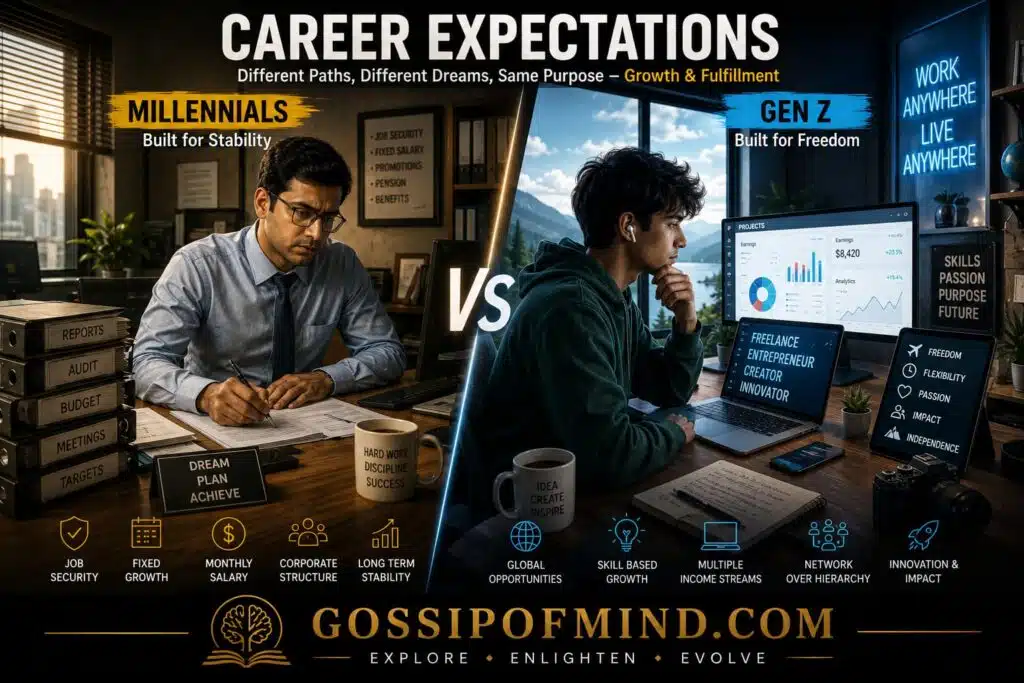
Career Expectations: Every Generation Chases a Different Dream
Career choices reveal how dramatically the world has changed.
For many Millennials, success followed a familiar path.
Study hard.
Earn a degree.
Find a stable job.
Build a secure future.
Government services, engineering, medicine, banking, and teaching were considered the safest and most respected careers.
Parents often guided these decisions because information about alternative careers was limited.
Today, Generation Z sees an entirely different landscape.
A teenager can become a software developer without attending a traditional university.
A designer can work for clients across five continents.
A teacher can educate millions through online platforms.
A creator can build a global audience from a single smartphone.
Artificial Intelligence has created professions that did not exist a decade ago, while simultaneously transforming careers that have existed for generations.
Opportunity has expanded beyond imagination.
But so has competition.
Today’s young professional is no longer competing only with classmates or neighbors.
They are competing with talented individuals from every corner of the world.
This new reality demands something more valuable than talent.
It demands continuous learning.
In the past, education often ended with graduation.
Today, graduation is simply the beginning.
Knowledge expires faster.
Skills evolve continuously.
Curiosity has become a career advantage.
And adaptability has become one of the most valuable skills of the twenty-first century.
Perhaps the future will not belong to the generation that knows the most.
It will belong to the generation that never stops learning.
A Seed Never Chooses Its Soil
Imagine planting the same seed in three different places.
One grows in fertile soil.
Another struggles in a dry desert.
A third grows inside a carefully protected greenhouse.
Years later, the trees look completely different.
Would it be fair to say that one seed was born superior?
Or would it be more accurate to acknowledge that each seed was shaped by the environment in which it grew?
Human beings are remarkably similar.
We are influenced by our families.
Our teachers.
Our communities.
Our opportunities.
Our struggles.
Our failures.
Our technology.
Our culture.
The year we are born may place us inside a generation.
But the environment in which we grow determines far more about who we become.
And perhaps that is the greatest misunderstanding behind every generational debate.
Beyond Psychology: What Timeless Wisdom Can Teach Us About Generations
Modern psychology explains how our environment shapes behavior. Sociology explains how societies influence values. Technology explains why different generations think differently.
But philosophy asks a much deeper question.
Can we ever become truly free from the environment that shaped us?
This is where some of history’s greatest thinkers offer remarkable insights.
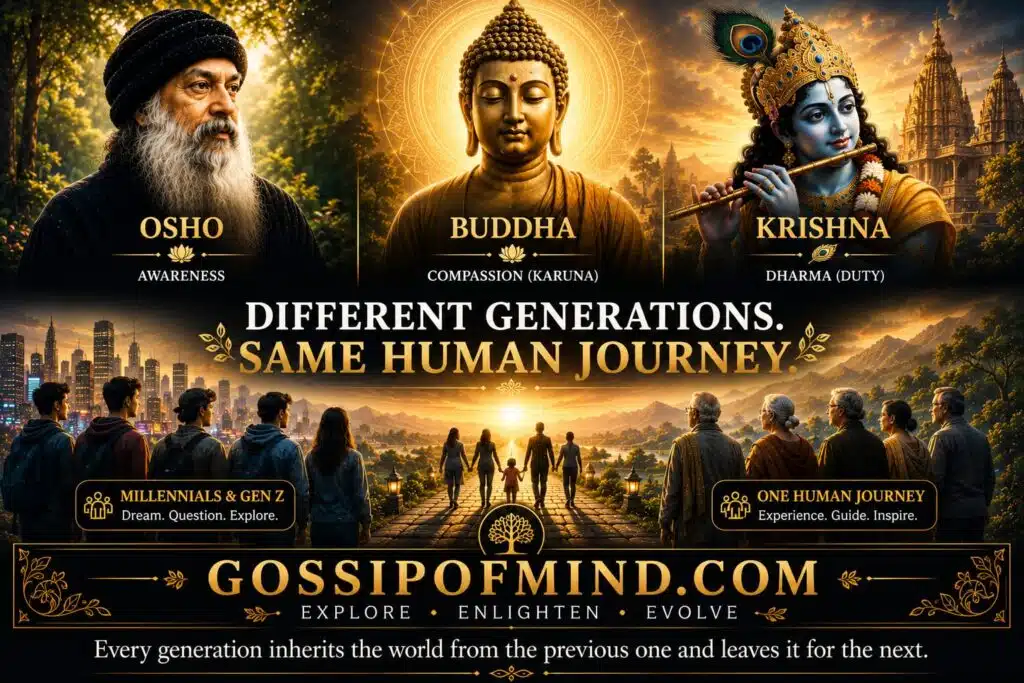
Although Osho, the Buddha, and the Bhagavad Gita never discussed Millennials or Generation Z, their teachings help us understand something far more important than generations—the human mind itself.
The reflections below are not direct quotations. They are interpretations of timeless philosophies applied to a modern question.
Osho: The Invisible Prison Called Conditioning
One of Osho’s most repeated ideas was that human beings are deeply conditioned.
From childhood, society begins writing its beliefs into our minds.
Parents teach us what success means.
Schools teach us what intelligence means.
Society teaches us what respect means.
Culture teaches us what is acceptable.
Slowly, we begin believing that these borrowed ideas are our own.
Osho challenged this illusion.
He believed that true intelligence begins when we become aware of our conditioning instead of unconsciously living through it.
Seen through this lens, Millennials and Generation Z are not opponents.
They are simply people conditioned by different worlds.
Millennials grew up in an environment that rewarded patience, stability, and gradual progress.
Generation Z is growing up in a world that rewards speed, adaptability, innovation, and digital fluency.
Neither environment is completely right.
Neither is completely wrong.
Each creates strengths.
Each creates blind spots.
The real question, according to Osho’s philosophy, is not:
“Which generation is better?”
The real question is:
“Can you see how your environment has shaped your thinking?”
The moment awareness begins, blind comparison loses its power.
The Buddha: Different Forms of the Same Human Struggle
More than twenty-five centuries ago, the Buddha taught that suffering arises from ignorance, attachment, and craving.
Time has changed.
Technology has changed.
Civilizations have changed.
But the human mind has changed far less than we imagine.
One generation struggled because it had too little.
Another struggles because it has too much.
One searched desperately for opportunities.
Another struggles to choose among endless opportunities.
Scarcity creates one kind of anxiety.
Abundance creates another.
The form changes.
The struggle remains.
The Buddha’s teaching of Right View encourages us to see reality without pride or prejudice.
His teaching of mindfulness reminds us to observe our thoughts before becoming controlled by them.
Applied to today’s world, technology itself is neither the hero nor the villain.
A smartphone can educate a curious mind.
The same smartphone can distract an unconscious one.
Artificial Intelligence can become humanity’s greatest educational tool.
Or it can become another shortcut that weakens independent thinking.
The deciding factor is never the technology.
It is always the awareness of the person using it.
Perhaps the Buddha would invite us to ask a different question altogether.
Not,
“Which generation is winning?”
But,
“Is my mind becoming wiser, calmer, and more compassionate?”
Because wisdom has never depended on the century in which we live.
It depends on the quality of our awareness.
The Bhagavad Gita: Character Outlives Every Generation
The Bhagavad Gita offers yet another timeless perspective.
It never divides humanity into generations.
Instead, it focuses on something far more enduring—character.
According to the Gita, every human being is born into circumstances they did not choose.
Some are born into comfort.
Some into hardship.
Some into peace.
Others into conflict.
Our birth is not our achievement.
Nor is it our failure.
What truly defines us is how we respond to the circumstances we inherit.
This idea transforms the entire debate about generations.
Millennials did not choose to grow up before smartphones.
Generation Z did not choose to be born into the age of Artificial Intelligence.
Neither generation selected its starting point.
But every individual chooses whether to live with integrity, discipline, humility, and responsibility.
The Bhagavad Gita reminds us that comparing ourselves with others often strengthens the ego rather than wisdom.
Real growth begins when comparison gives way to self-mastery.
Technology may shape our abilities.
Society may shape our opportunities.
But only character determines our legacy.
Perhaps this is the common thread connecting psychology, philosophy, and spiritual wisdom.
The year you are born explains your circumstances.
The choices you make define your life.
Are We Really Comparing Intelligence?
One of the most common claims in every generation is, “We are smarter than the generation before us.” But before accepting or rejecting that statement, we must first ask a more important question:
What is intelligence?
Is intelligence the ability to memorize facts?
Is it the speed of finding information?
Is it creativity?
Is it emotional maturity?
Is it wisdom?
Or is it the ability to solve difficult problems under changing circumstances?
The truth is that intelligence has never had a single definition.
A scientist, an artist, a teacher, an entrepreneur, and a parent may all demonstrate intelligence in completely different ways.
Likewise, every generation expresses intelligence differently because every generation faces different problems.
Older generations built roads, institutions, industries, and technologies with limited resources.
Newer generations are expanding those achievements through digital innovation, artificial intelligence, and global collaboration.
Neither contribution is greater.
One laid the foundation.
The other continues the construction.
Human civilization has always advanced in this way.
Every generation receives a world it did not create.
Then it improves that world before handing it to the next.
That is not competition.
That is cooperation across time.
What About Generation Alpha?
Today, social media is busy comparing Millennials with Generation Z.
A decade from now, Generation Alpha may compare itself with Generation Z in exactly the same way.
The cycle will repeat.
The names will change.
The arguments will remain the same.
Perhaps this tells us something important.
The debate has never really been about Millennials or Gen Z.
It has always been about the human tendency to believe that our own experience is the standard by which everyone else should be judged.
History repeatedly proves otherwise.
Every generation becomes the “older generation” sooner or later.
The young eventually become the experienced.
The experienced eventually become the mentors.
And one day, every generation discovers that the future belongs to those who come after them.
Conclusion: The Best Generation Is the One That Keeps Learning
Perhaps the greatest mistake we make is believing that generations compete with one another.
They do not.
They complete one another.
Millennials remind us that patience, perseverance, and long-term commitment still matter.
Generation Z reminds us that curiosity, innovation, and adaptability are essential in a rapidly changing world.
Neither generation possesses all the answers.
Neither generation represents perfection.
Each carries strengths that the other needs.
The world does not move forward because one generation defeats another.
It moves forward because every generation leaves something valuable behind.
Osho’s philosophy reminds us that awareness begins when we recognize our conditioning.
The Buddha reminds us that wisdom grows when comparison gives way to mindfulness.
The Bhagavad Gita reminds us that character is greater than circumstance and that our actions matter more than the era into which we are born.
Perhaps the real question was never,
“Which generation is better?”
Perhaps the better question has always been,
“What kind of human being am I becoming?”
Because the year you are born may decide your generation.
The world you grow up in may shape your thinking.
But your daily choices shape your character.
And your character shapes your legacy.
In the end, history does not remember generations for the technology they inherited.
It remembers them for the values they left behind.
Frequently Asked Questions
Who are Millennials?
Millennials generally refer to people born between 1981 and 1996.
Who belongs to Generation Z?
Generation Z generally includes people born between 1997 and 2012.
Is Gen Z smarter than Millennials?
There is no scientific evidence that one generation is inherently more intelligent than another. Different generations develop different strengths because they grow up in different environments.
Why do Millennials and Gen Z think differently?
Their childhood experiences, technology, education, parenting styles, economic conditions, and social environments were different. These factors naturally influence attitudes and behavior.
What is the biggest difference between Millennials and Gen Z?
The biggest difference is their relationship with technology. Millennials witnessed the digital revolution, while Generation Z was born into it.
What does psychology say about generations?
Psychology suggests that human behavior is strongly influenced by environment, upbringing, learning, culture, and lived experiences rather than birth year alone.
What can we learn from Osho, the Buddha, and the Bhagavad Gita?
Although they lived in different times, all three emphasize self-awareness, wisdom, and character over labels and comparison. Their teachings encourage us to understand ourselves before judging others.
References
Pew Research Center – Generational definitions and demographic research.
World Economic Forum – Future workplace and skills trends.
Interpretive discussion inspired by the teachings of Osho.
Mindfulness and Right View inspired by early Buddhist teachings.
Character, duty, and self-mastery interpreted from the Bhagavad Gita (especially Chapters 2, 3, and 6).
Final Reflection
People are not defined by the year they are born. They are shaped by the world that raises them—and remembered for the values they leave behind.
A Note to Our Readers
At gossipofmind.com, we believe meaningful conversations begin with understanding, not comparison.
Every generation carries unique strengths, faces different challenges, and leaves behind lessons for the next. If this article encouraged you to see another generation with greater empathy, please consider sharing it with your family, friends, or colleagues.
Sometimes, one thoughtful conversation can bridge a generation gap.
Disclaimer
This article is intended for educational and informational purposes only. The discussions on psychology, technology, and generations are based on publicly available research and widely accepted interpretations.
The sections discussing Osho, the Buddha, and the Bhagavad Gita present interpretive reflections inspired by their teachings and should not be considered direct quotations or official doctrinal interpretations.
Generational boundaries (Millennials, Generation Z, etc.) follow commonly accepted research definitions, while recognizing that individual experiences and personalities vary greatly.
Leave a Reply