
Have you ever replayed the same conversation in your mind dozens of times? Have you spent sleepless nights worrying about mistakes from the past or uncertainties about the future?
If your answer is yes, then you have experienced overthinking.
In today’s fast-paced world, overthinking has become one of the most common mental struggles. While thinking helps us solve problems and make better decisions, excessive thinking can trap us in a cycle of anxiety, stress, and self-doubt.
Let us understand what overthinking is, why it happens, its harmful effects, and how we can overcome it.
What Is Overthinking?
Overthinking is the habit of repeatedly analyzing situations, problems, conversations, or future possibilities without reaching a meaningful conclusion.
A person who overthinks often gets stuck in endless mental loops. Instead of taking action, they continue to imagine different outcomes, revisit past events, and worry about future uncertainties.
Healthy thinking helps us grow.
Overthinking keeps us stuck.
Why Do People Overthink?
Unrealistic Expectations: Many people place excessive expectations on themselves and others. When reality fails to meet those expectations, the mind begins analyzing every possible reason behind the disappointment.
Relationship Insecurities: Relationships are one of the biggest sources of overthinking. Questions like “Does this person really care about me?” or “Why haven’t they replied yet?” create endless mental stress.
Ego and Fear of Failure: People often fear making mistakes or appearing imperfect. This fear causes them to overanalyze every decision before taking action.
Comparing Ourselves with Others: Social media has made comparison easier than ever. Constantly comparing our lives, careers, or relationships with others fuels overthinking.
Lack of Present-Moment Awareness: When the mind is not anchored in the present, it naturally drifts toward regrets about the past and worries about the future.
The Harmful Effects of Overthinking
Poor Sleep Quality: Overthinking intensifies at night, making it difficult to fall asleep peacefully.
 Anxiety and Mental Stress: Constant mental analysis increases anxiety and emotional exhaustion.
 Reduced Productivity: Overthinkers spend more time thinking than acting, leading to missed opportunities.
 Relationship Problems: Misunderstandings and assumptions created by overthinking damage bonds.
 Loss of Inner Peace: A mind that never stops thinking rarely experiences true happiness.

What Buddha Taught About Overthinking
Buddha observed that much of human suffering comes from attachment to the past and anxiety about the future. One of the most powerful teachings associated with Buddhism is:
“Do not dwell in the past. Do not dream of the future. Concentrate the mind on the present moment.”
According to Buddha, mindfulness is the key to overcoming overthinking. When we become fully aware of the present moment, unnecessary thoughts gradually lose their power. The more present we become, the less we suffer from mental noise.

What Osho Said About Overthinking
Osho believed that thinking is useful, but excessive thinking becomes a disease. According to Osho, most people live inside their minds rather than experiencing life directly.
He emphasized meditation, silence, and self-observation (Witnessing or Sakshi Bhaav) as tools for breaking free from constant mental chatter.
“Don’t fight with the mind. Just be a witness, a silent observer. When thoughts are observed without judgment, they naturally begin to disappear.”

What the Bhagavad Gita Teaches About Overthinking
he Bhagavad Gita provides one of the most practical solutions to overthinking. When Arjuna became overwhelmed by confusion and fear on the battlefield, Lord Krishna guided him toward action rather than endless mental analysis.
Lord Krishna gives the ultimate formula for a calm mind in Chapter 2, Verse 47:
“Karmanye vadhikaraste ma phaleshu kadachana,
Ma karmaphalaheturbhurma te sangostvakarmani.”
(You have the right to perform your duty, but you are not entitled to the fruits of your actions.)
Much of our overthinking comes from worrying about results that are beyond our control. The Gita teaches us to focus on our actions while letting go of excessive attachment to outcomes. When we concentrate on effort rather than results, the mind becomes calmer and more focused.
How to Stop Overthinking
Stay Busy with Meaningful Work: An idle mind creates unnecessary worries. Engaging in productive activities reduces mental clutter.
Follow a Healthy Routine: A structured daily routine gives the mind stability and discipline.
Limit Screen Time Before Sleep: Avoid mobile phone usage before bedtime. Read a book or practice meditation instead.
Focus on the Present: Ask yourself: “What can I do right now?” This brings attention back to the immediate moment.
Replace Overthinking with Planning: Write down a simple plan and take the next small step.
Planning vs. Overthinking
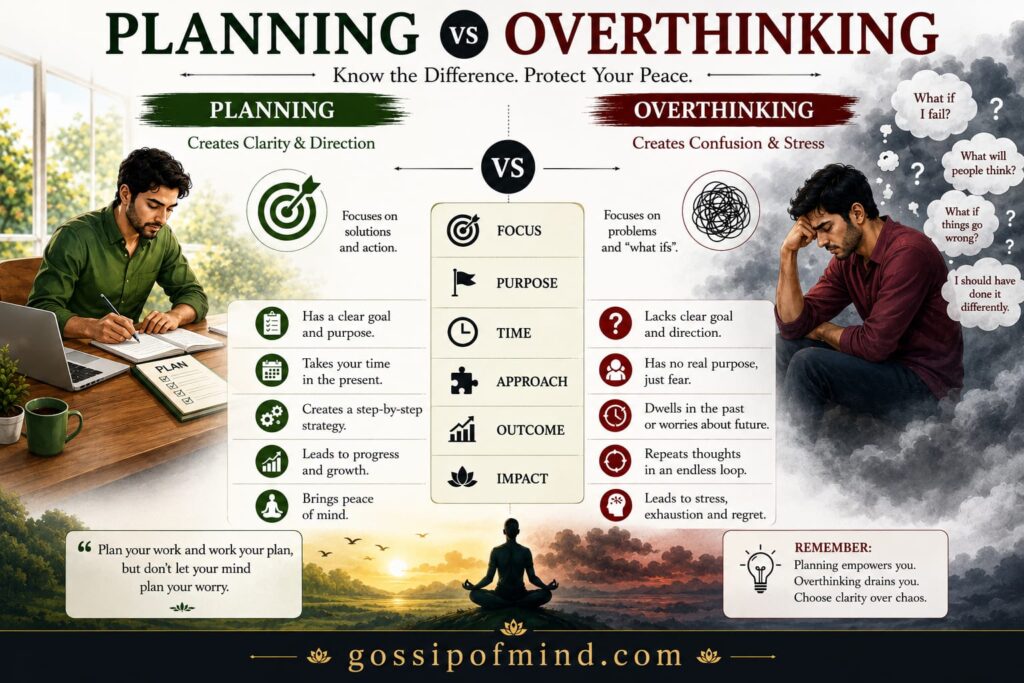
| Planning | Overthinking |
| Focuses on solutions | Focuses on problems |
| Leads to action | Leads to anxiety |
| Creates clarity | Creates confusion |
| Moves life forward | Keeps life stuck |
The goal is not to stop thinking. The goal is to think effectively and act confidently.
Conclusion
Overthinking is one of the silent enemies of happiness. It steals our peace, weakens our confidence, and prevents us from fully enjoying life.
The wisdom of Buddha, Osho, and the Bhagavad Gita points toward the same truth:
- Live in the present.
- Observe your thoughts.
- Focus on action rather than outcomes.
The moment we replace endless thinking with conscious action, life becomes lighter, clearer, and more meaningful. Remember: Overthinking creates fear. Planning creates progress.
A Message for Readers
“If you find yourself trapped in endless thoughts, remember that peace does not come from controlling every outcome. It comes from living fully in the present moment. Take one small step today, trust the process, and allow life to unfold naturally.”
What is one thought that you have been overthinking lately? Share your experience in the comments below.
Leave a Reply